Challenge
Validate whether ML-Agents can drive a skillful, high-stakes kick loop while keeping multiplayer sessions deterministic and lightweight enough for instant access.
Approach
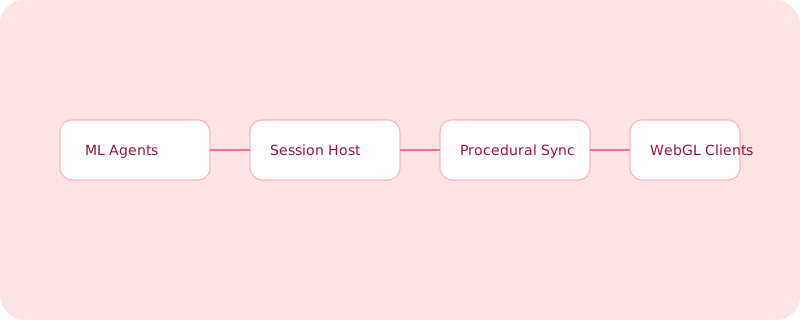
- Built an ML-Agents decision layer with 1:1 decision-to-outcome mapping for clean credit assignment.
- Implemented reward shaping tied to distance-to-goal deltas.
- Designed host-authoritative multiplayer with deterministic seed-based generation.
- Added a WebGL devserver to enable zero-install testing and rapid iteration.
Results
- Training behavior became easier to tune through high-level action control.
- Deterministic session flow reduced host/client uncertainty.
- Web-first testing made iteration faster and easier to share.
Key metrics
| Metric | Before | After |
|---|---|---|
| Decision layer | Manual tuning | ML-Agents policy |
| Session sync | Manual checks | Deterministic seed sync |
| Testing loop | Install required | WebGL instant access |
- High-level policies trained faster and generalized to procedural variance.
- Deterministic seeds simplified multiplayer sync and validation.
- WebGL testing accelerated iteration without sacrificing confidence.